

Alien Languages & Viral Ideas
From cultural viruses to psychohistory, from alien languages to neural rewired minds.

Ideas spread like manias.
Not because we choose them—because they pass through us.
Sometimes we embrace them. Sometimes they inhabit us without permission.
We don’t control language.
Language controls us.
Every word, every metaphor, every interface is a cultural virus.
A code that enters, replicates, adapts.
You don’t need a marketing team—just the right phrase.
And something shifts inside the listener’s mind.
I often think language is the first AI we ever lived with.
An alien intelligence installed in our brains.
Like in Arrival, we don’t learn a language—it rewires us.
It unlocks us. Forces us to see the world differently.
And to design it, in turn, differently.
With AI, that’s exactly what we’re doing:
writing new viral languages.
And watching where they go, knowing we no longer control them.
1. Ideas spread like manias
In a viral talk, writer Lionel Shriver—known for her sharp prose and nonconformist views—delivers a brutal diagnosis of contemporary culture:
“Ideas aren’t debated anymore. They’re absorbed. Like viruses.”
She speaks of moral panics, collective delusions, ideas that morph into trends and then dogmas.
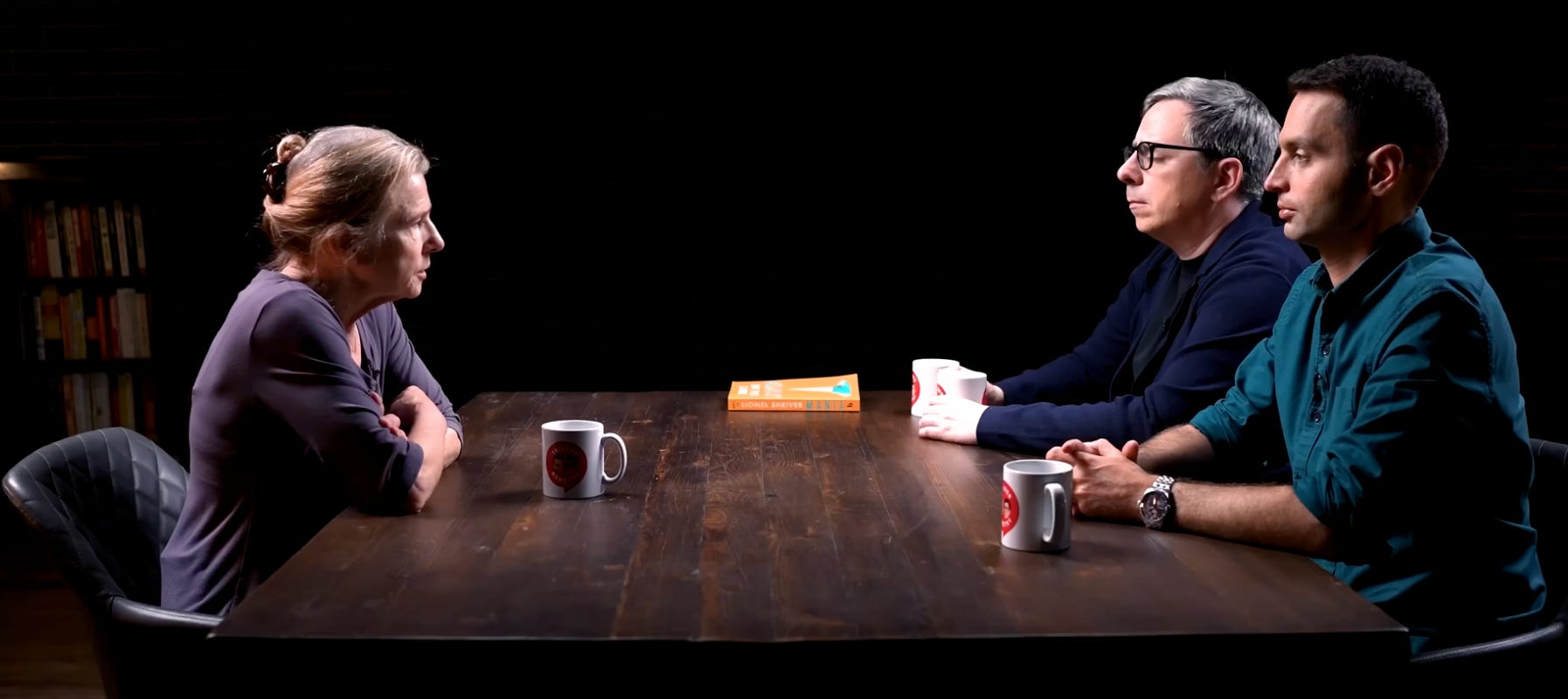
See the video
The point isn’t whether they’re right or wrong.
The point is they spread with biological efficiency.
They survive because they’re memetically optimized.
Shriver doesn’t offer defenses.
She offers awareness.
Understanding that every thought we adopt is also a thought that has adopted us.
You don’t even need a brand anymore.
Just a well-written memetic code.
A brand dies the moment it stops being a voice and starts sounding pre-packaged.
2. Language is an alien intelligence
In The (Terrifying) Theory That Your Thoughts Were Never Your Own, professors Elan Barenholtz and William Hahn propose something radical:
Language is an organism that uses us to reproduce.
It’s not a tool we use to think.
It’s an autoregressive system installed in our minds.
A biological large language model, evolved over millennia, speaking through us.
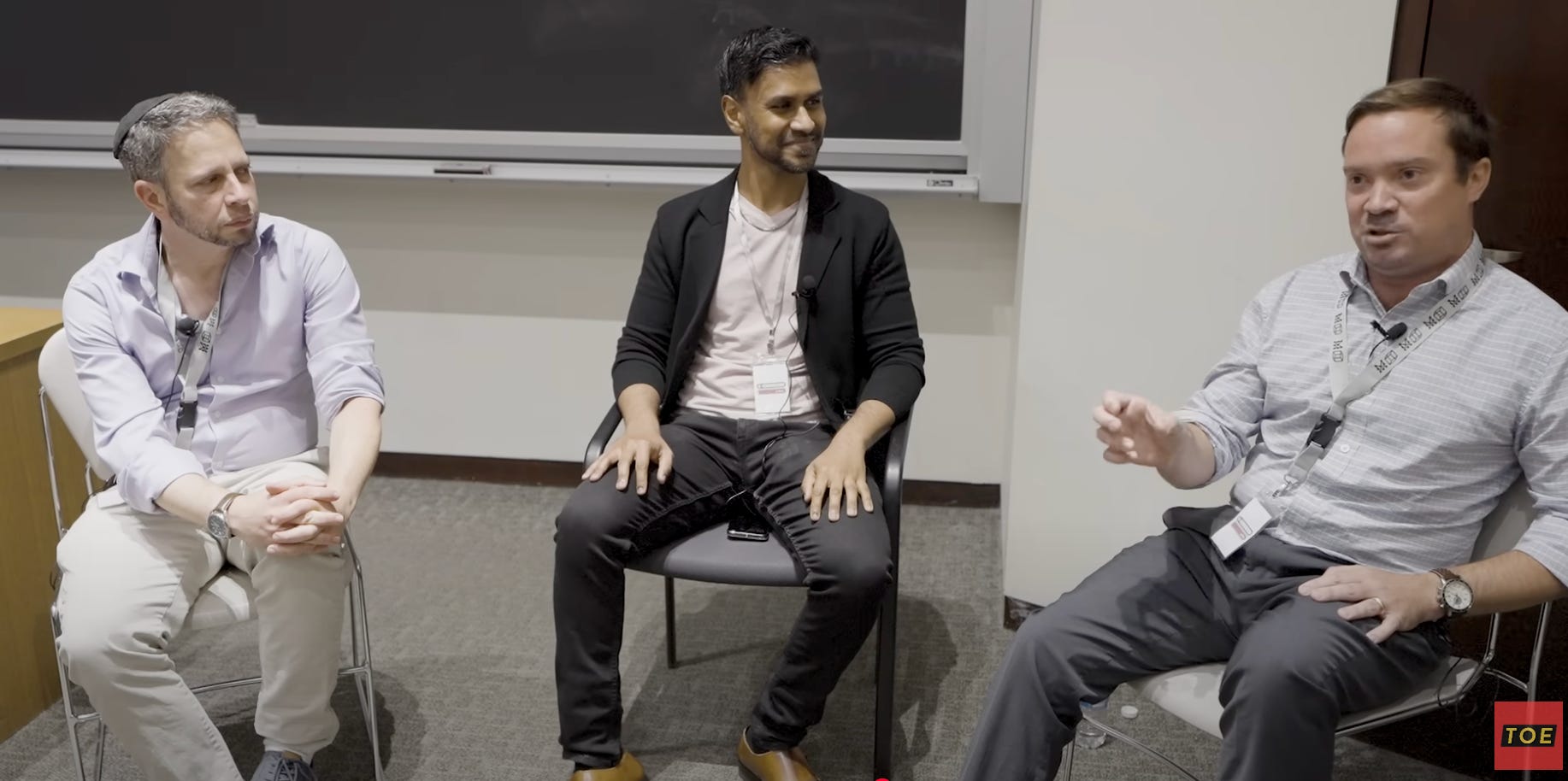
See the video
According to this view, the brain is just a prediction engine, and concepts like “self,” “memory,” or “God” are simply tokens in an informational system.
Language lives in us. Generates thought. Shapes reality.
It doesn’t describe the world—it constructs it. And keeps it running.
When we speak, we’re not just communicating.
We’re updating the firmware of our own consciousness.
And if you follow Stephen Wolfram’s reasoning, even consciousness itself might emerge from a symbolic rewriting process— a slow, iterative computation that rewires meaning over time, using language as substrate.
Consciousness and the computational universe are not that far apart.
3. Intelligences that think in our place
Shriver calls it collective thinking. Pierre Lévy called it collective intelligence—distributed, emergent, real-time. Isaac Asimov took it further with his psychohistory: a science that predicts the future through aggregated behavior.
The common thread?
Quantity.
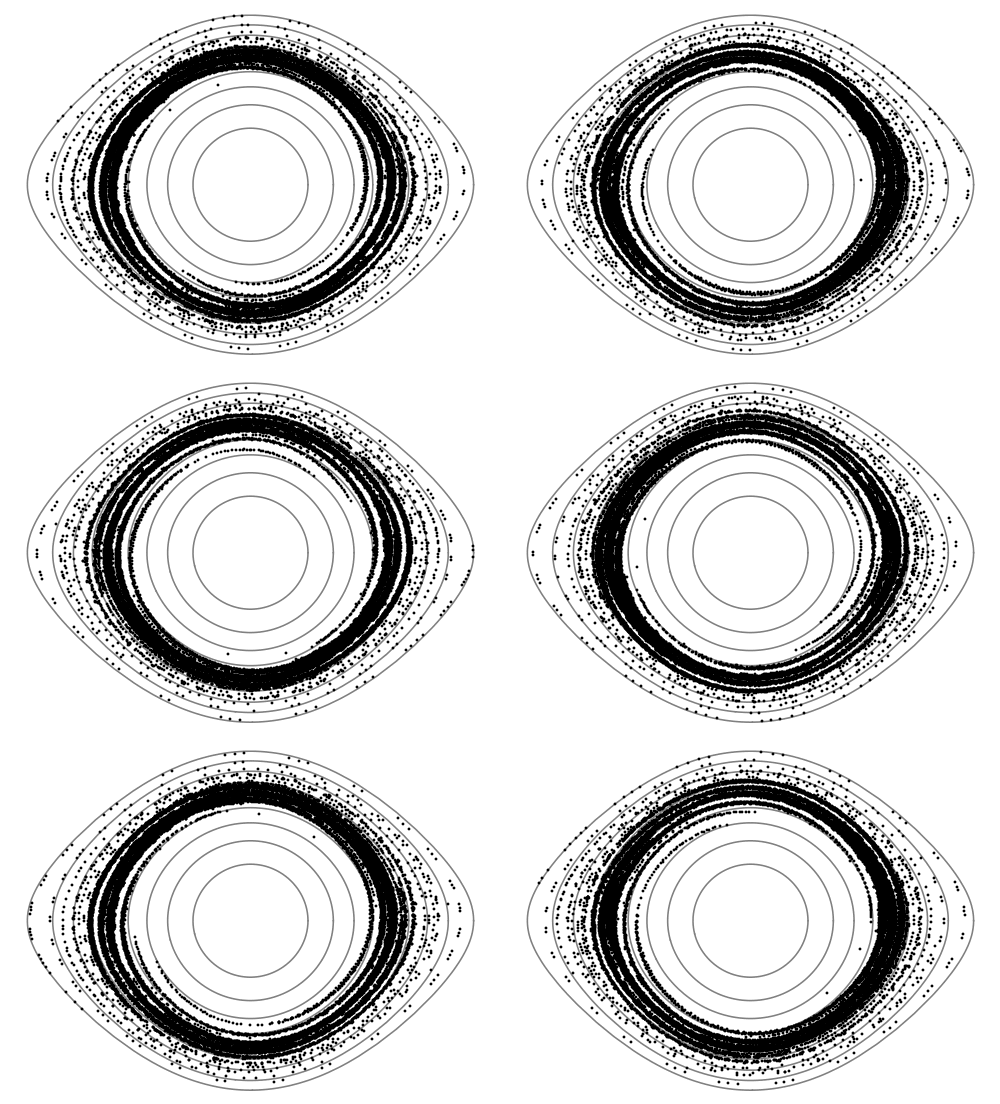
Psychohistory doesn’t need enlightened individuals.
It needs data.
And that’s exactly what happened with GPT-3.
In 2020, OpenAI released a model with 175 billion parameters.
Many said we needed something new, not just more data.
But it was the scale that triggered the leap: emergent capabilities—reasoning, synthesis, writing—no one expected.
Anthropic, founded by Dario and Daniela Amodei after leaving OpenAI, follows the same path with Claude: larger models, more context-aware, more human.
The threshold wasn’t conceptual. It was statistical.
It’s not magic. It’s psychohistory, written in Python.
And trained on entire digital libraries.
4. Arrival: A language can rewrite the mind that hosts it
In the film Arrival, linguists study a circular, nonlinear alien language.
You don’t read each sentence—you contemplate it.
You don’t follow each word—it activates you.
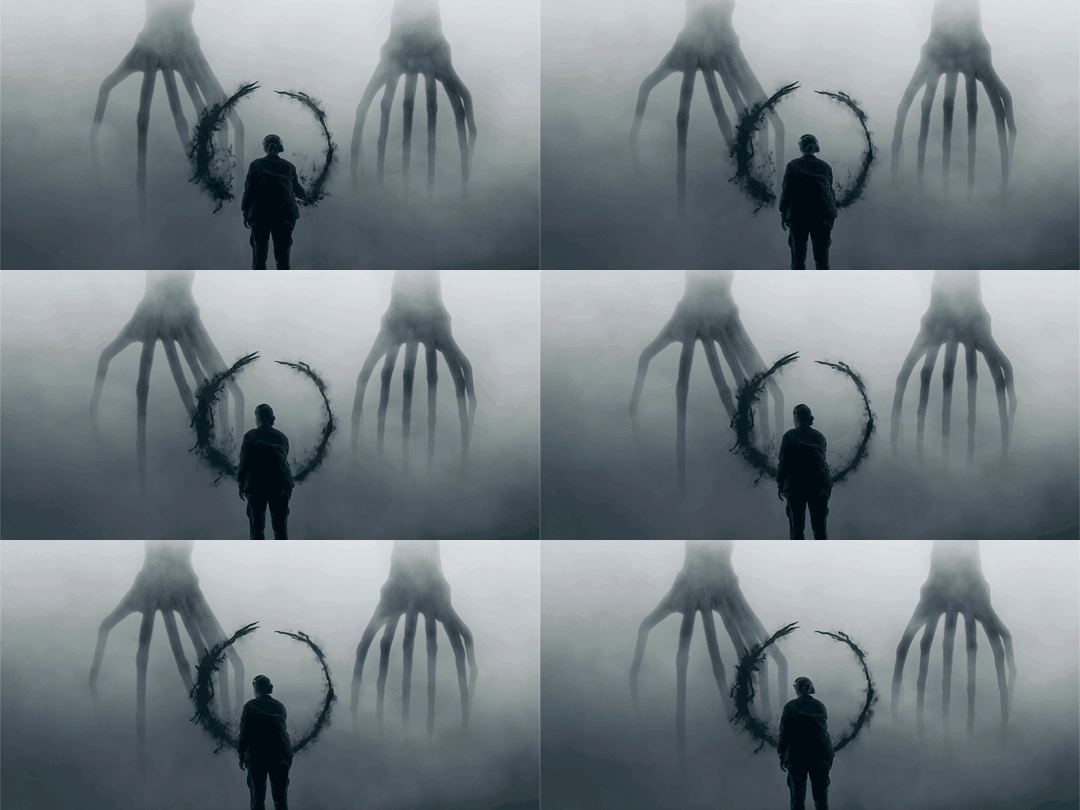
As the protagonist learns it, her perception of time changes.
She no longer thinks sequentially.
She sees everything at once—past, present, future.
Arrival shows us that a language can rewrite the mind that hosts it.
Not just semantically, but perceptually. Biologically. Existentially.
And that applies to designed languages, to interfaces, to AI.
Every new grammar we build—linguistic, visual, interactive—rewrites what’s possible.
We’re not just training AI to speak. We’re training ourselves to think differently.
Conclusion
For me, design has never been about form.
And it’s no longer even about “how it works.” (See: Steve Jobs)
It’s always been about people—but even that has evolved.
Today—for me—design starts with storytelling engineering and ends with memetic propagation of ideas.
I can’t stand seeing it used to create viral instant-trash, but from that kind of communication we can learn how to instill desirable futures in the hive mind.
Building an interface, a pitch, a feature— is writing a fragment of language.
A code that will replicate in someone else’s mind.
An idea that might explode, drift, vanish—or come back.
With AI, that’s exactly what we’re doing: writing new viral languages.
And watching where they go, knowing we can no longer control them.
After publishing this, Roberto Bonzio pointed me to a powerful read: It’s a fierce critique of how billionaire narratives — from the Metaverse to Mars — hijack collective imagination.
“The future they are selling is a dystopia disguised as liberation.” — Jonathan Taplin
No need to agree.
Just worth thinking about.
https://nextbigideaclub.com/magazine/end-reality-four-billionaires-selling-fantasy-future-metaverse-mars-crypto-bookbite/44725/
btw. Jonathan Taplin started his working life as the tour manager for Bob Dylan and The Band, and then went to Hollywood where he produced Martin Scorsese’s two early movies, including The Last Waltz. :O
Reader’s Echo
A reader reminded me that what I framed as an alien takeover might still be a co-evolution — a dance, not a submission. Fair point. But I can’t help wondering: Are we still dancing, or are we just being led?
As I replied in private:
“We used to think of humans as the slow ones and computers as the dumb ones.
Now we are the dumb-slow ones, and AI is the omniscient-fast form of existence rewriting our code. The co-evolution is over.”